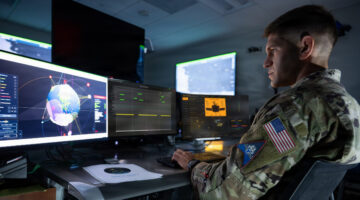
How US military space operators are likely aiding the fight in Iran
While senior officials have offered praise with few details, experts told Breaking Defense space ops likely include jamming or spoofing satellite communications.
Col. Felix Torres, commandant of the Army’s SMDC Center of Excellence, told Breaking Defense recruiting 1,000 new space specialists does not signal the Army is "trying to take over [Space Force's] job, or anything like that."
Gen. Stephen Whiting, commander of US Space Command, today revealed his "Apollo Maneuvers" exercise concept involving satellite movements, responsive launch and "spectrum maneuvering."
Gen. Dan Caine, Joint Chiefs of Staff chairman, on Jan. 3 gave a shout-out to the roles played by US Space Command and US Cyber Command in Operation Absolute Resolve.
The bilateral rendezvous and proximity operation "illustrates France's ability to conduct dynamic and responsible operations to deter adversaries from acting against its space interests," according to France's Space Command.
Building dynamic space operations concepts will be necessary to force "flexibility," and provide capabilities for "maneuver and surprise" on orbit, the new report by the Mitchell Institute says.
US Space Command has now completed two rendezvous and proximity operations with partners in Multinational Forces Operation Olympic Defender: France and Britain.
Space watchers and Alabama politicians have been predicting the move, as President Donald Trump had decided on Redstone Arsenal in Huntsville as SPACECOM’s home just before he left the Oval Office for the first time in January 2021.
The Space Force, however, has been lukewarm on funding support for what it calls "Space Access, Mobility and Logistics."
One area where China has "moved breathtakingly fast is the fielding of a suite of counter space weapons," Gen. Stephen Whiting told Breaking Defense in his only press interview on a trip through Australia.
Discover how unmanned systems and emerging technologies are shaping the future of U.S. naval power in Breaking Defense’s new eBook.
"While this type of close approach activity does not automatically signify a military mission, it obviously could provide a co-orbital counterspace capability," expert Victoria Samson told Breaking Defense.
Crank said that while he hopes the caucus eventually will be bipartisan, at the moment he and Strong are the only members.
Based on its orbital pattern, independent astronomer Marco Langbroek said he suspected the new satellite is joining other Russian "sleeping interceptors."
Some decision-making authorities, previously closely held by the president or secretary of defense, have been delegated to US SPACECOM, according to sources, but military space leaders want more freedom to act.